
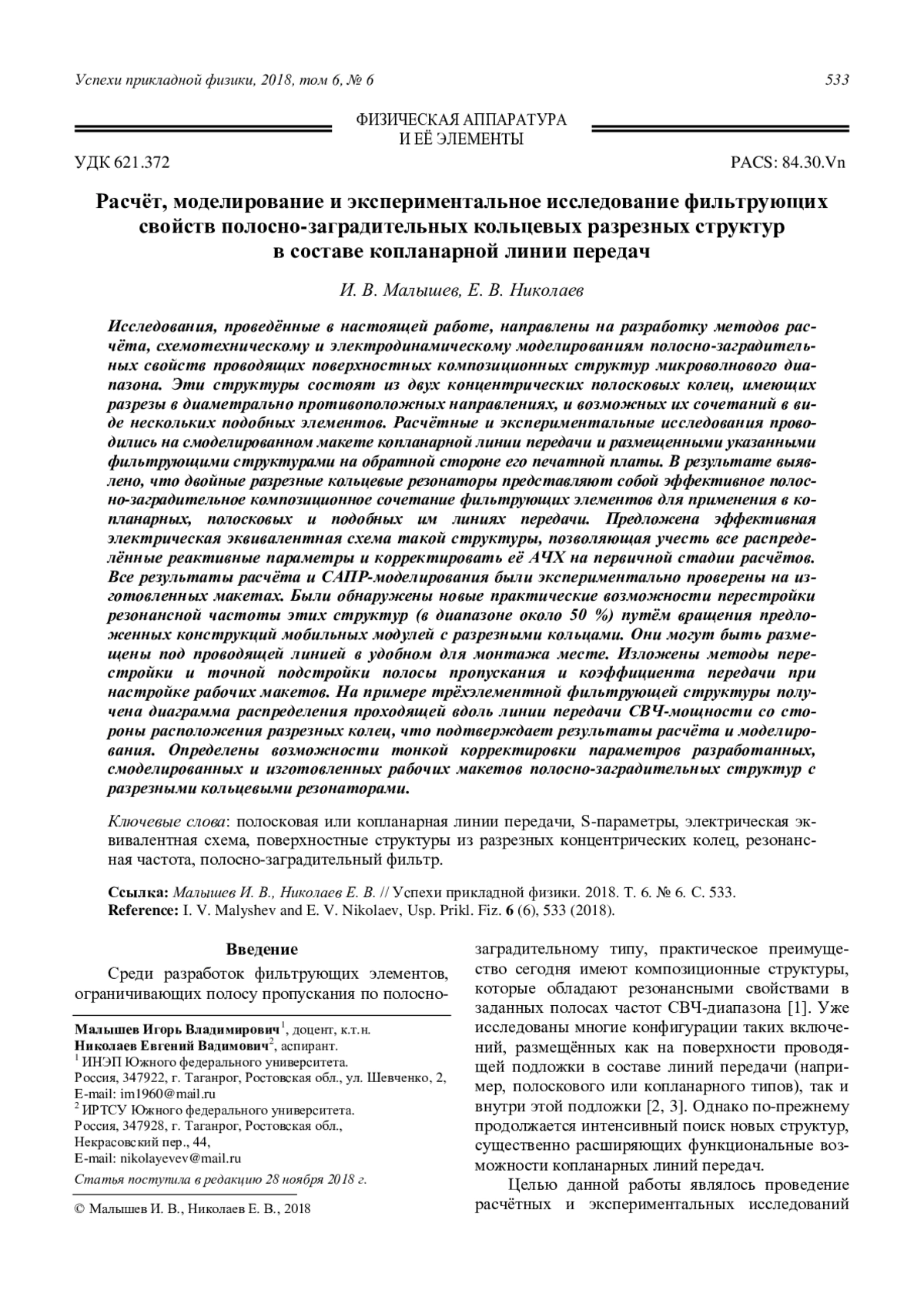
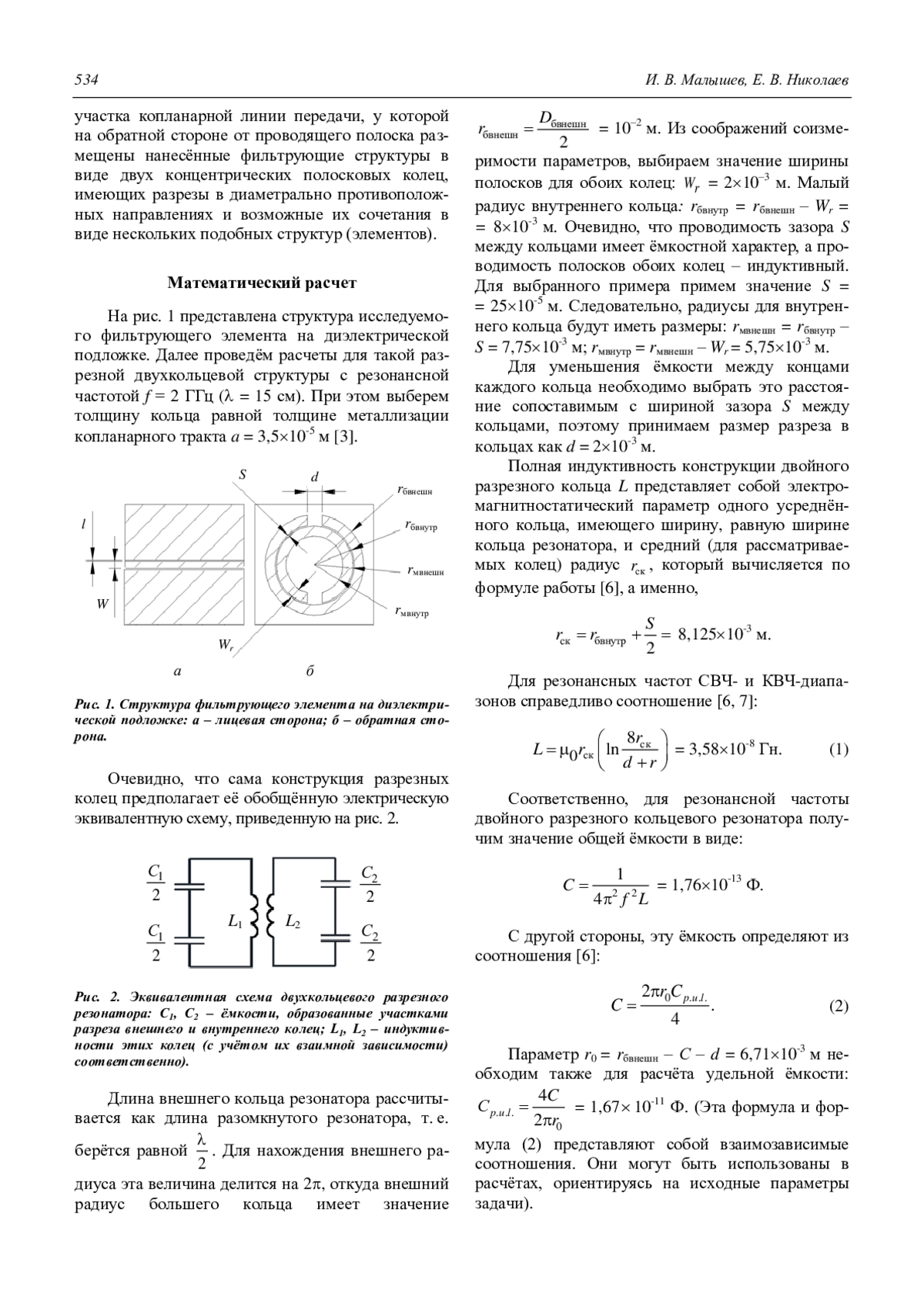
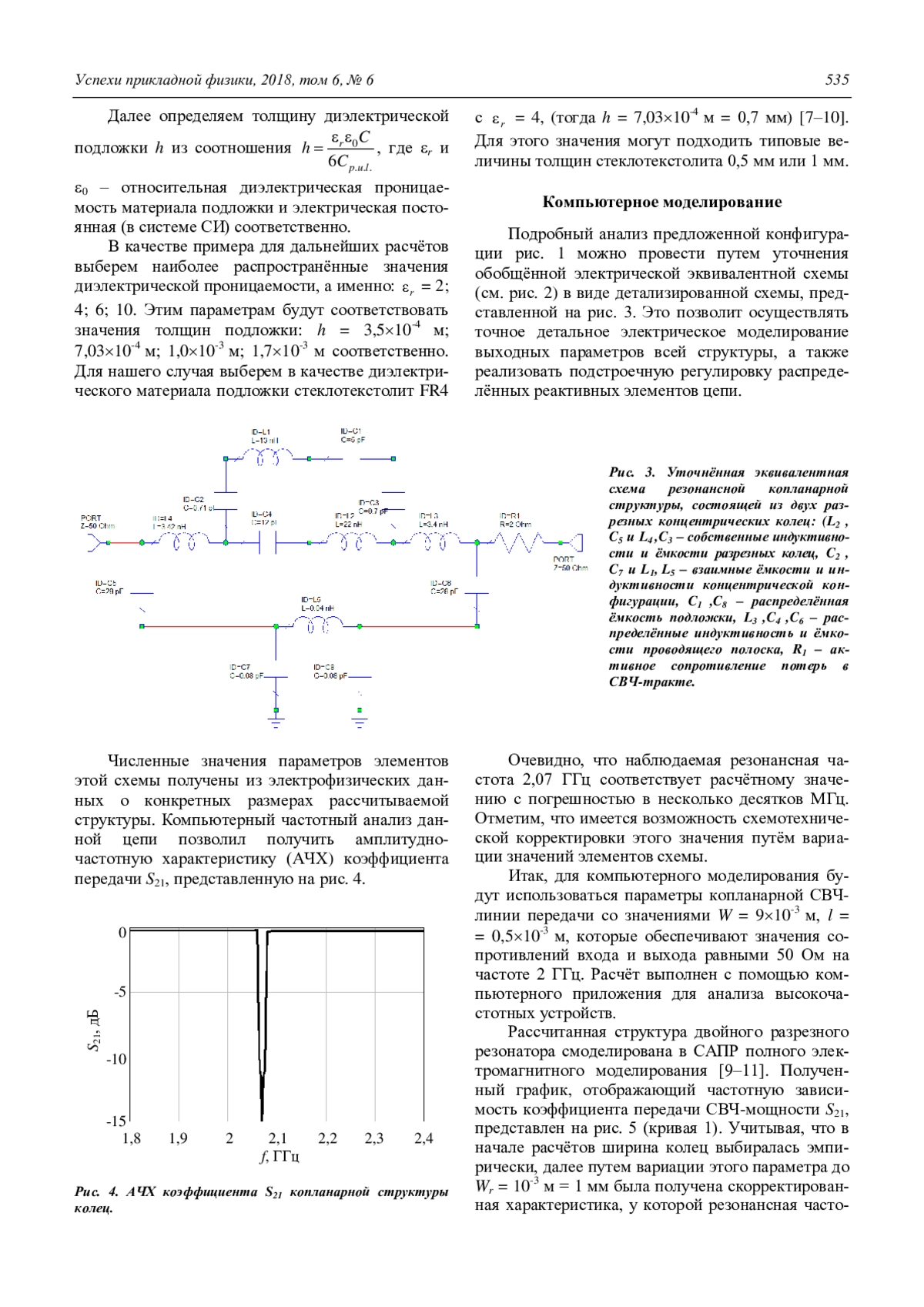
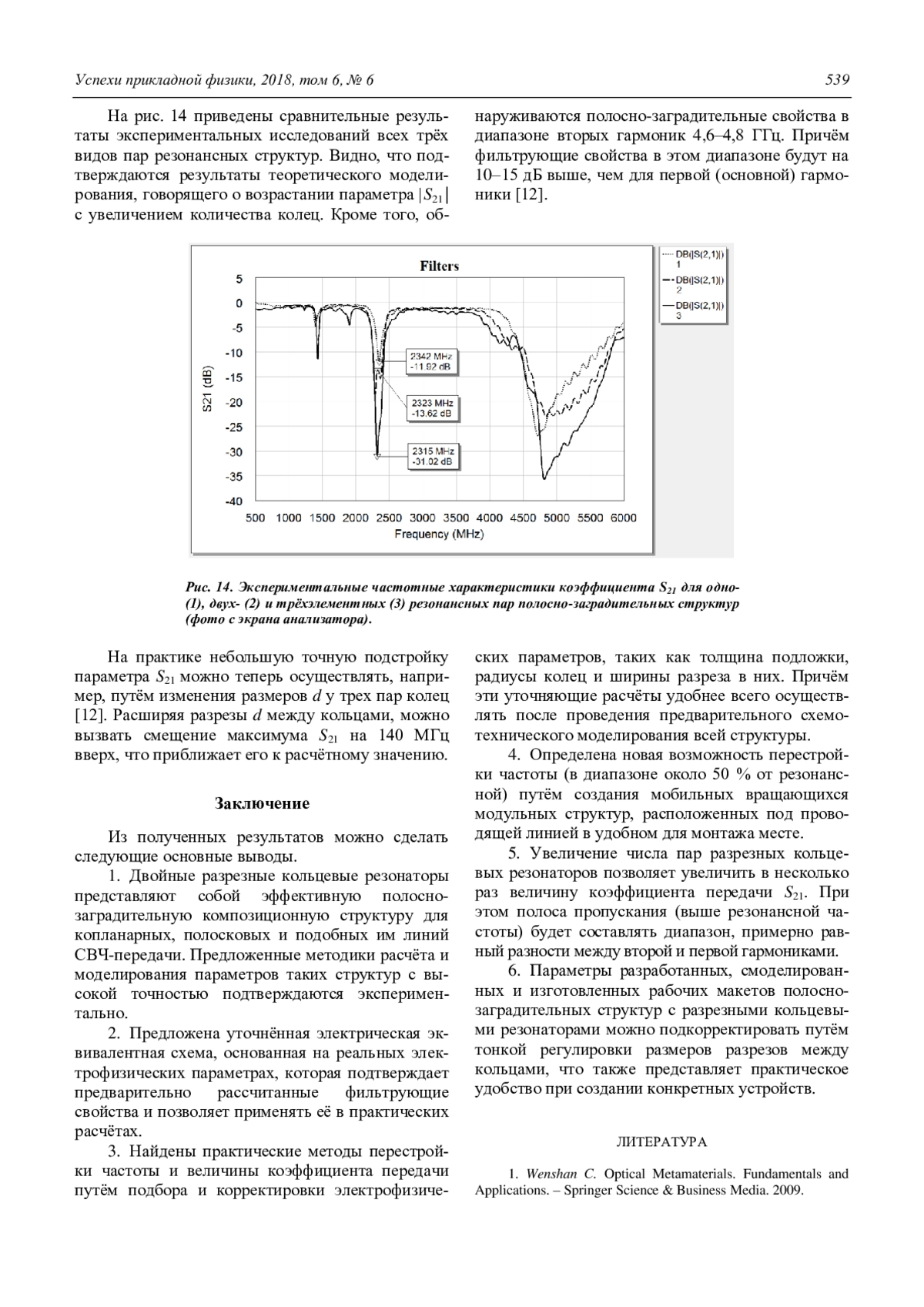
Исследования, проведённые в настоящей работе, направлены на разработку методов расчёта, схемотехническому и электродинамическому моделированиям полосно-заградительных свойств проводящих поверхностных композиционных структур микроволнового диапазона. Эти структуры состоят из двух концентрических полосковых колец, имеющих разрезы в диаметрально противоположных направлениях, и возможных их сочетаний в виде нескольких подобных элементов. Расчётные и экспериментальные исследования проводились на смоделированном макете копланарной линии передачи и размещенными указанными фильтрующими структурами на обратной стороне его печатной платы. В результате выявлено, что двойные разрезные кольцевые резонаторы представляют собой эффективное полосно-заградительное композиционное сочетание фильтрующих элементов для применения в копланарных, полосковых и подобных им линиях передачи. Предложена эффективная электрическая эквивалентная схема такой структуры, позволяющая учесть все распределённые реактивные параметры и корректировать её АЧХ на первичной стадии расчётов. Все результаты расчёта и САПР-моделирования были экспериментально проверены на изготовленных макетах. Были обнаружены новые практические возможности перестройки резонансной частоты этих структур (в диапазоне около 50 %) путём вращения предложенных конструкций мобильных модулей с разрезными кольцами. Они могут быть размещены под проводящей линией в удобном для монтажа месте. Изложены методы пере-стройки и точной подстройки полосы пропускания и коэффициента передачи при настройке рабочих макетов. На примере трёхэлементной фильтрующей структуры получена диаграмма распределения проходящей вдоль линии передачи СВЧ-мощности со стороны расположения разрезных колец, что подтверждает результаты расчёта и моделирования. Определены возможности тонкой корректировки параметров разработанных, смоделированных и изготовленных рабочих макетов полосно-заградительных структур с разрезными кольцевыми резонаторами.
The studies conducted in this paper are aimed at developing calculation methods, circuit design and electrodynamic modeling of the strip-barrier properties of conducting microwave-range surface composite structures consisting of two concentric strip rings having cuts in diametrically opposite directions and possible combinations of them in the form of several similar elements.. Design and experimental studies were carried out on the example of a printed circuit board with a coplanar transmission line and the indicated filtering structures located on the reverse side of the printed circuit board. As a result, it was revealed that double split ring resonators represent an effective band-barrier composite composition of filter elements for use in coplanar, strip and similar transmission lines. An effective electrical equivalent circuit of such a structure is proposed, allowing to take into account all distributed reactive parameters and to correct its frequency response at the primary stage of calculations. All the results of the calculation and CAD modeling were experimentally tested on the fabricated layouts. New practical possibilities were discovered for restructuring the resonant frequency of these structures (in the range of about 50 %) by rotating the proposed designs of mobile modules with split rings. They can be placed under the conductive line in a convenient place for installation. The methods of adjustment and finetuning of the bandwidth and transmission coefficient when setting up working layouts are described. Using the example of a three-element filtering structure, a tetrahedral MLFMM-grid decomposition of the structure was carried out to simulate the distribution of EMI and the distribution diagram of the microwave power passing along the transmission line was obtained from the side of the arrangement of the split rings, which confirms the results of the calculation and simulation. The possibilities of fine adjustment of the parameters of the developed, modeled and manufactured working models of strip-barrier structures with split ring resonators are determined.
Предпросмотр статьи
Идентификаторы и классификаторы
- SCI
- Физика
- eLIBRARY ID
- 36690447